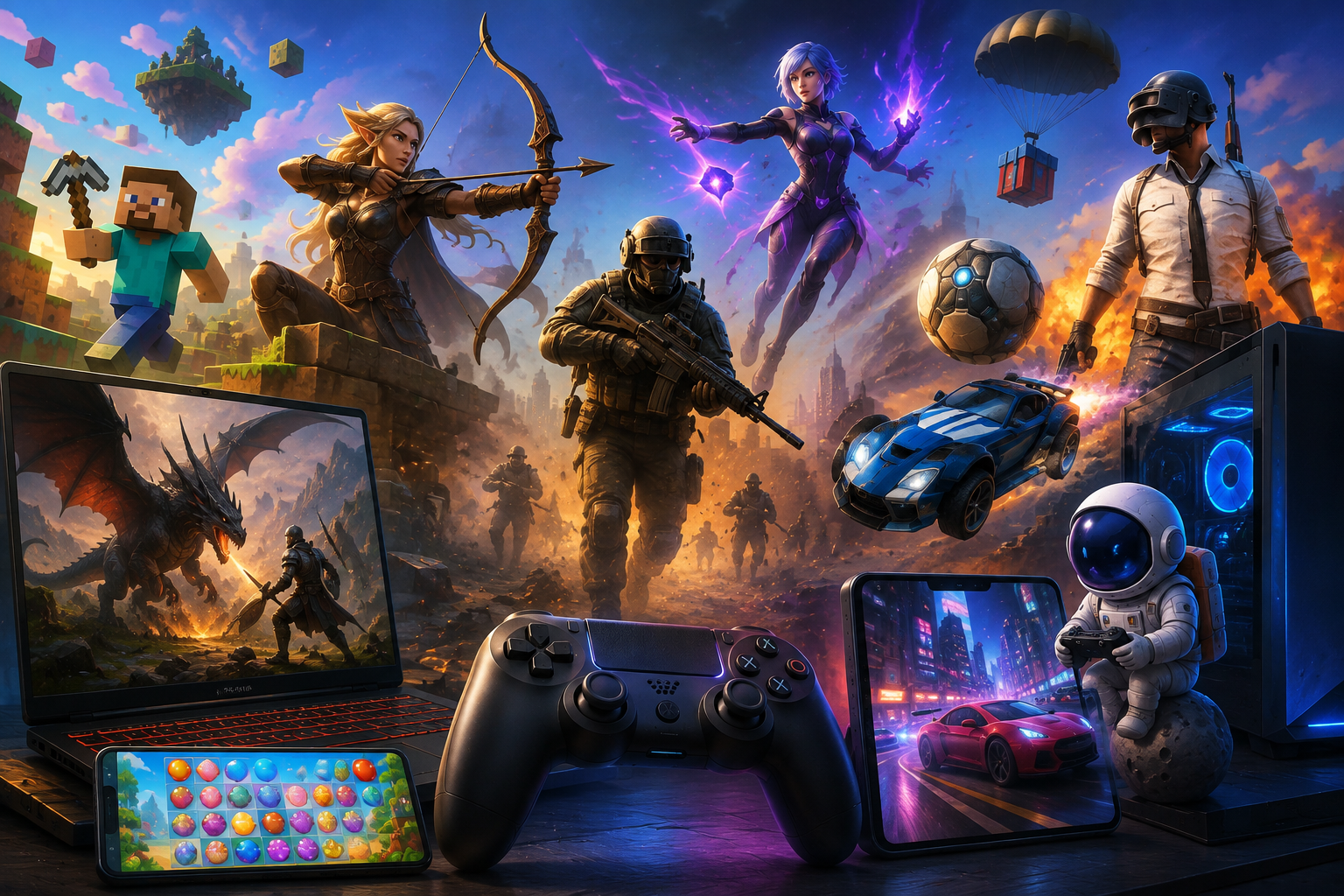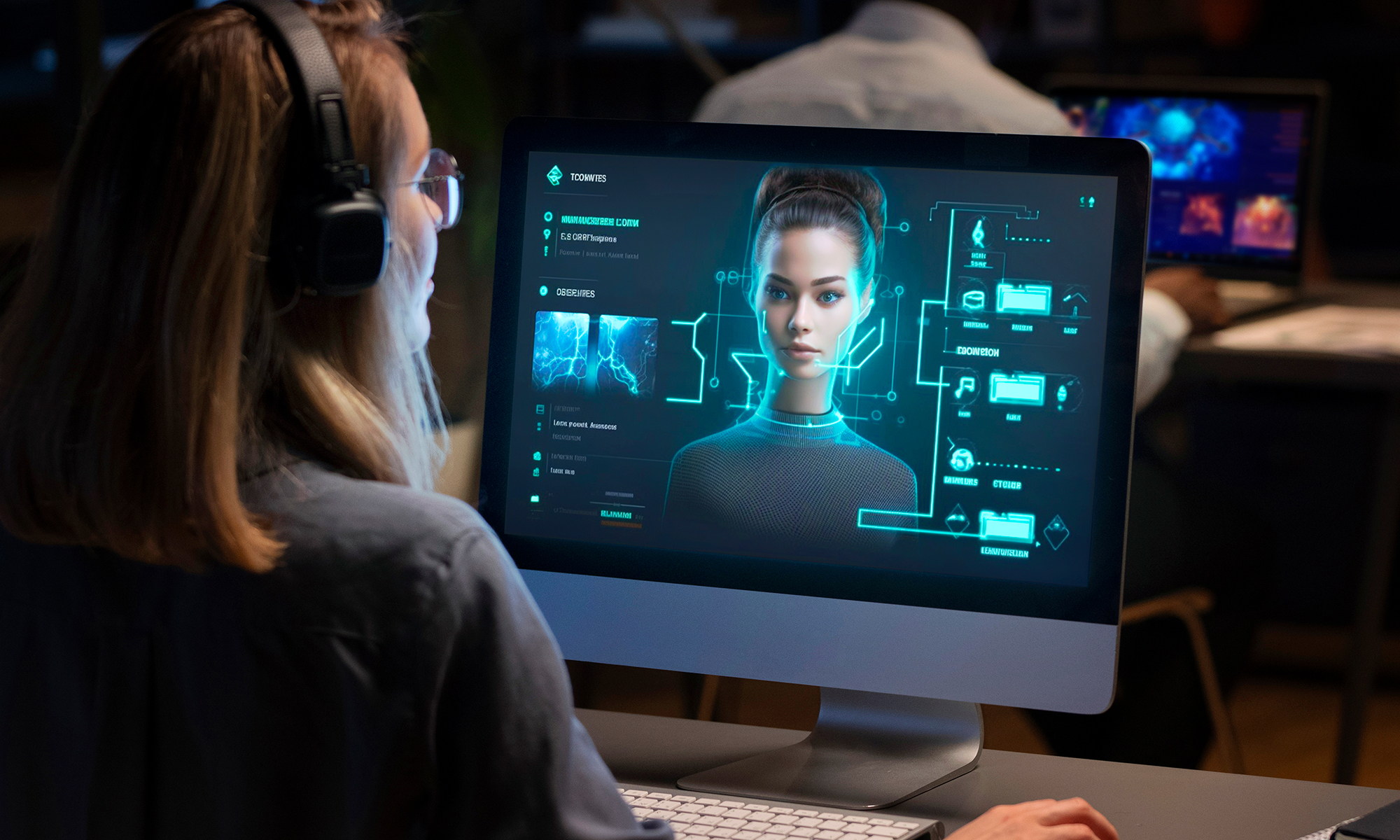
AI is increasingly playing a significant role in current game creation tools. AI is no longer just a tool for simple automation. There are new AI-powered tools available that may assist in coding, character behavior, game assets, testing, and ideas for game design.
Popular game engines, including Unity, Unreal Engine, and Godot, are also seeing changes in their use due to the development of AI. AI assistants and coding agents can streamline repetitive tasks and free up developers’ time to focus on creative decisions.
However, how exactly is AI impacting game development software, and what does that imply for game developers?
What Is AI Game Development Software?
AI game development software is tools that leverage artificial intelligence to help with various aspects of video game development.
AI can assist developers in various ways, such as:
- Develop and refine game code
- Generate ideas for characters and environments
- Build 2D and 3D objects
- Apply skills to create dialogue and character behavior
- Find coding errors
- Test game mechanics
- Improve workflows
- Eliminate repetitive development activities
While some may see this as a complete overhaul of the development process, the majority of the current AI tools serve as aids to assist developers in completing certain tasks in a more efficient manner.
What Are The Ways AI Is Making A Positive Impact On Game Development?
AI is one of the major benefits of being able to reduce repetitive tasks. AI tools can write code, interpret computer programming issues, provide simple computer assets, or offer solutions.
For instance, using an AI coding assistant to generate a simple player-movement system. The generated code can then be changed by the developer according to the needs of a game.
This can be especially helpful for small development teams with a tight budget and schedule.
AI Is Accelerating Game Coding
Programming is one of the most crucial components of game development, but it also can be time consuming.
AI coding tools can facilitate coding, provide explanations for unfamiliar functions, detect potential bugs, and support with more extensive programming projects. New progress is making way beyond auto-filling to AI-driven agents that can operate across multiple files and test or debug code.
This can be helpful for beginners to understand programming concepts. For advanced developers, AI can also assist in streamlining repetitive coding tasks.
But developers still need to audit AI-generated code, as generated code can be buggy or end up being an issue with performance.
Generate Game Assets With AI
Making game assets can be time-consuming and require some skills.
AI tools can help to create or build:
- Character concepts
- Environment ideas
- Textures
- 3D models
- Animations
- Sound effects
- Music concepts
- Dialogue
This will enable smaller teams to test ideas without developing all the assets from scratch.
One of the most beneficial aspects of AI asset generation is its utility in the early stages of development, where developers may wish to rapidly experiment with various visual styles.
AI Is Improving NPCs And Gameplay
AI can also make a significant impact on non-player characters (NPCs), often referred to as ‘robots’. Another field in which AI can play a big role is in non-player characters (or NPCs) – the ‘robots’ that are also known as AI.
NPCs frequently follow the rules they have been programmed with. Developers set certain conditions that define the actions of a character.
These systems can be made more flexible with the added support of AI, enabling characters to react to various scenarios or player moves.
In today’s game development processes, AI-driven systems and NPC technologies are already utilized, such as in mobile game development.
In the long run, this may help make characters more responsive and predictable in game worlds.
AI Can Be Used For Game Testing
Before a game is released, it should be tested.
Developers must find crashes, bugs, broken mechanics, performance issues, and other problems. Manual testing of a big game could be time-consuming.
Automatic testing with AI systems can help by automatically playing certain game areas and detecting strange gameplay.
Some newer development tools even try to incorporate AI agents that can build, test, debug, and even visually confirm applications. For example, Meta’s experimental XR Operator can help AI coding agents to go through parts of the build-and-test procedure for VR applications.
While human testing is still significant, AI can assist developers in completing more repetitive testing tasks.
AI Is Transforming Popular Game Engines
AI is making its way into a wide range of aspects in the game-engine landscape.
Unity has been building its own AI features for in-app assistance, and AI features are being created on top of Unreal Engine and Godot.
This can often allow developers to avoid the need to switch to a completely new AI platform. The capabilities of AI can be woven into the software they already use.
This outcome might be a more unified development environment whereby developers can leverage traditional tools and AI support in the same workflow.
So What Are The Advantages For Indie Game Developers?
AI could be a game-changer for independent developers and smaller studios.
In a large game studio, there could be different programmers, artists, designers, writers, testers, and technical specialists. Many of these tasks can be performed by a small team with a few individuals.
Some of that workload can be alleviated by using AI tools.
As an example, an AI developer might be able to:
- Make an initial game idea
- Generate basic programming assistance
- Create provisional visual material
- Develop dialogue ideas
- Try out some game aspects
- Recognize coding issues
This is not to say that anyone can just simply make a high-quality AAA game. Rather, AI can provide less-resourced teams with more tools to try out and develop projects.
Can AI Take The Place Of Game Developers?
AI is transforming the developer’s job but not replacing human talent.
Game development involves much more than generating code or images. There are still decisions to be made regarding gameplay, performance, story, user experience, art direction, monetisation, and game quality for developers.
Content produced via AI can also need editing and quality assurance.
The best way to work with AI is thus to use it as a development assistant, and not expect it to solve all of a game project’s problems.
What Are The Challenges Of AI In Game Development?
While the advantages are great, there are also some challenges when using AI.
Accuracy
The code or assets generated by AI might not always be accurate. The output must be tested and reviewed by the developers.
Consistency
Generated characters, environments, etc. might not always adhere to the same visual style.
Copyright and Ownership
Developers should become familiar with the licensing and usage terms of AI-generated content and the tools they employ.
Security
If not reviewed carefully, AI-generated code may contain vulnerabilities or suboptimal coding practices.
Cost
There are subscription- or usage-based pricing models for some advanced AI tools. The developers should think about if the productivity gains outweigh the cost.
What Will The Future Of Game Development Software Look Like?
AI is expected to be increasingly embedded in game development tools.
New tools could let game makers explain a game action to a system in natural language and then generate a base game action. In addition, AI systems can be improved to more efficiently test games, analyze player interactions, generate assets, and handle repetitive game development tasks.
You would think the most significant shift would be that AI will actually generate entire games on its own. Rather, game development software may develop into something more interactive, letting AI to be a partner to developers throughout development.
Recent studies on independent software development (ISD) also indicate advances in the development of AI systems that can self-plan, self-code, self-test, and self-improve in an iterative process.
Final Thoughts
AI is revolutionizing game development software by simplifying numerous development processes and making them faster. AI is being utilized in various aspects of game development, including coding, creating assets, testing, and NPC behavior.
For developers, it’s not about how much AI you can get into the code; it’s about making sure that it’s the right amount. Rather, focus on tasks that are repetitive or time-intensive and can be effectively supplemented by AI without sacrificing human creativity and quality assurance in the development process.
With advancements in AI technology, the software used for game development will increasingly be smarter, more automated, and user-friendly.
FAQs
What are the applications of AI in the gaming industry?
AI can help with coding, character creation, NPC behaviour, game testing, dialogue, design ideas, and more.
Is it possible to build a fully-fledged video game solely using AI?
While AI can help with various aspects of game development, the production of a successful commercial game still requires human planning, development, testing, and creative decision-making.
Can indie game devs make use of AI?
Yes. Small teams can save repetitive work and try out ideas faster with the help of AI.
Is there a possibility that AI could take the role of game developers?
AI is more apt to transform the developer landscape than to eliminate developers. Human creativity, technical judgment, testing, and game design are still important.
What game development software can take advantage of AI?
You can find AI tools and integrations in most of the game development ecosystems, including Unity, Unreal Engine, and Godot, though functionality can differ from one to another, both within and across those ecosystems.